
Mold Testing in Durango, Cortez and Southwest Colorado
Find out what is in the air, how it compares with outdoors, and whether it points to moisture. Lab results in 24 hours, explained in plain terms.
What can prompt a mold test
These are the situations where people choose to test, and where the result is most useful.
A musty smell with no visible source
Something is damp somewhere. The test shows whether it has reached the air and which types are involved.
A known leak, flood or roof problem
Past water is the usual start of a mold problem. A test shows whether it left anything behind.
Staining you want explained
A stain can be old and dry or a sign of something active. The air sample from that room helps tell which.
A damp basement or lower level
Lower levels hold moisture longest. A sample there is compared with the outdoor air and the rest of the house.
A baseline before closing
Know what the air looked like on the day you bought the house.
A check after cleanup
Confirm that a cleanup or repair did what it was supposed to do.
What a mold test tells you
A lab report is more than a single number. It breaks the air in each location down by type, amount and source.
Which molds are in the air
Each type the lab looks for gets its own row. You see what is there, not only that something is.
How much of each
A count for every type and a total for each location, in spores per cubic meter of air.
How indoors compares with outdoors
Every indoor number is set against an outdoor sample taken the same visit. The labels Acceptable, Slightly Elevated and Elevated come from that comparison.
Whether it points to moisture
Types that need materials to stay wet, such as Stachybotrys and Chaetomium, are flagged as water-damage indicators. They are rare in my outdoor samples.
Where in the house
Each location gets its own page. A clean living room page says nothing about the basement.
How it compares locally
I set your numbers against my own archive of local results, so you know whether they are ordinary for this area.
How the report reads
Every mold type in every room gets a tag and icons, so the page reads at a glance.
A tag for how it compares with outdoors
At or below the outdoor level.
Above the outdoor level. Common: 95 of every 100 reports have at least one.
Ten times the outdoor level or more. 14 of every 100 reports have at least one.
Icons for what kind of spore it is

Outdoor spore. Most likely drifted in from outside.

Reported allergen. True of most common molds.

Can produce mycotoxins. Some members can, under some conditions.

Water-damage indicator. Favors materials that stay wet. The one to notice.
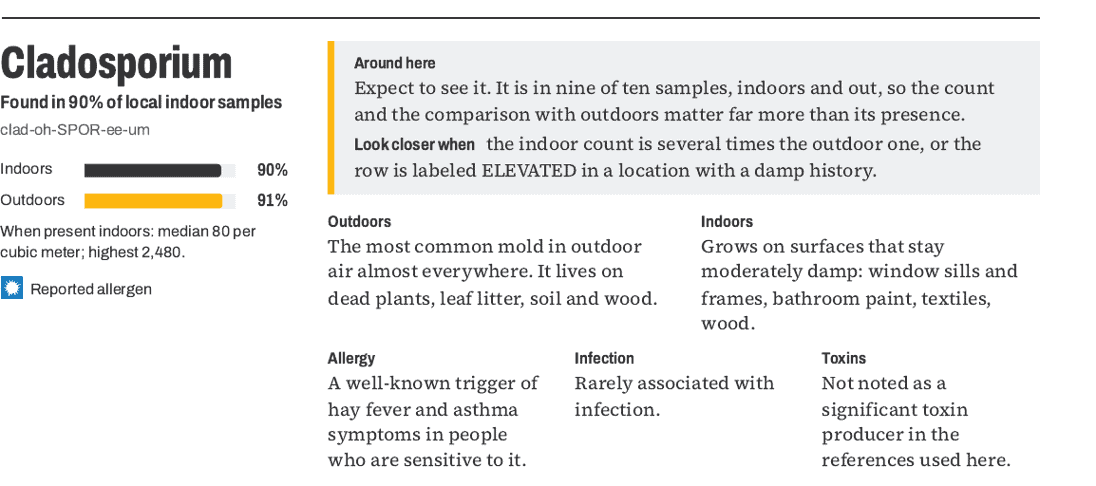
The Local Mold Glossary comes with every report. It has an entry for every mold type that has turned up in my tests: how often it shows up here indoors and out, where it lives, what it means indoors, and when to look closer. This is one entry.
What warrants a closer look
No single number decides it. These are the patterns worth following up with a closer look for a moisture source.
A water-damage type at more than a trace
Chaetomium or Stachybotrys in the hundreds is different from a single spore. A trace is one or two spores on the slide.
Aspergillus/Penicillium much higher inside than outside
It shows up in about 1 in 5 of my indoor samples, and it is often the largest type where a location runs more than double its outdoor sample.
An Elevated label on a type that is not an outdoor type
Ten times the outdoor level for a spore that can grow on building materials deserves a second look at that location.
How I test
- One sample outdoors, then the rooms that matter. The outdoor sample is the baseline for that day. Indoors it is usually a living room, then a bedroom, basement or kitchen.
- Samples go to the lab overnight. The lab identifies and counts each type of spore.
- You get a guide with the report. I send the lab report with a guide to reading it and a glossary of the mold types found locally.
- You can call the lab. The lab will talk with clients directly about their report.
- I test. I do not do remediation. If the result calls for work, your agent can point you to a company they trust.
- On its own, or with an inspection. You do not have to be buying a house to have the air tested.
- Local context. I keep an archive of my own results, so I can tell you whether your numbers are low, in the normal range or on the higher side for this area.
Mold testing questions
Is some mold normal?
Yes. Outdoor air carries mold spores, and some of that comes indoors. Nearly 9 in 10 indoor locations I test have at least one type above its outdoor count.
How fast do I get results?
Samples ship overnight and the lab turns them around in 24 hours.
Can I test without a home inspection?
Yes. Mold testing is available on its own.
What if the result is high?
The report shows which types are elevated and whether they point to water damage. That tells you and a remediation contractor where to look. I do not do remediation. Your agent can point you to a company they trust.
Do I have black mold?
"Black mold" is not a lab term. People usually mean Stachybotrys, and the report has a row for it on every page. It shows up in about 1 in 10 of my indoor samples, and two times out of three it is one or two spores. A larger count, or any count where there is staining, a past leak or a musty smell, is worth following up.
Should the seller clean and retest?
Cleaning without fixing the moisture rarely lasts. Find the source first, then retest afterward if you want confirmation.
What do the mold names on the report mean?
Every report comes with my Local Mold Glossary. It has an entry for each mold type found in homes here: how often it shows up, where it lives, and when to look closer.
Who do I call with questions?
Call me, or call the lab directly.
The numbers on this page come from my own archive of lab results. They describe the homes I was hired to test, not every home in the area.